.png)
Our latest Blog Posts
Against the backdrop of surging order peaks during e-commerce promotion events, the rigid requirement of zero-delay material supply driven by flexible manufacturing, and the year-by-year increase in warehousing space costs, traditional logistics models have long been overloaded: pickers walk excessively for manual picking, forklift operations occupy passageways, fixed-path AGVs paralyze overall operations, frequent operation interruptions occur in stand-alone automation, and the overall efficiency even decreases rather than increases amid chaotic collaboration among multiple devices… Intelligent logistics upgrading is no longer a simple upgrade by adding several robots, but a systematic reconstruction of the entire link, all scenarios and all equipment.

In this industrial transformation, the collaborative operation mode of latent AMRs and unmanned forklifts, with its absolute advantages of “full flexibility, drastic efficiency improvement, sharp cost reduction and full-link unmanned operation”, has become the preferred solution for leading enterprises to implement intelligent upgrading. It completely breaks the limitations of stand-alone equipment, eliminates bottlenecks throughout the entire “picking-handling-storage-inbound & outbound” process, and deploys a unified system to schedule these two core types of equipment, enabling warehouse logistics to leap from “semi-automatic assistance” to the ultimate era of “full unmanned autonomous operation”. Then why is the collaboration between AMRs and unmanned forklifts the future of intelligent warehousing? How does it achieve accurate and efficient operations? What disruptive benefits can it bring to enterprises?
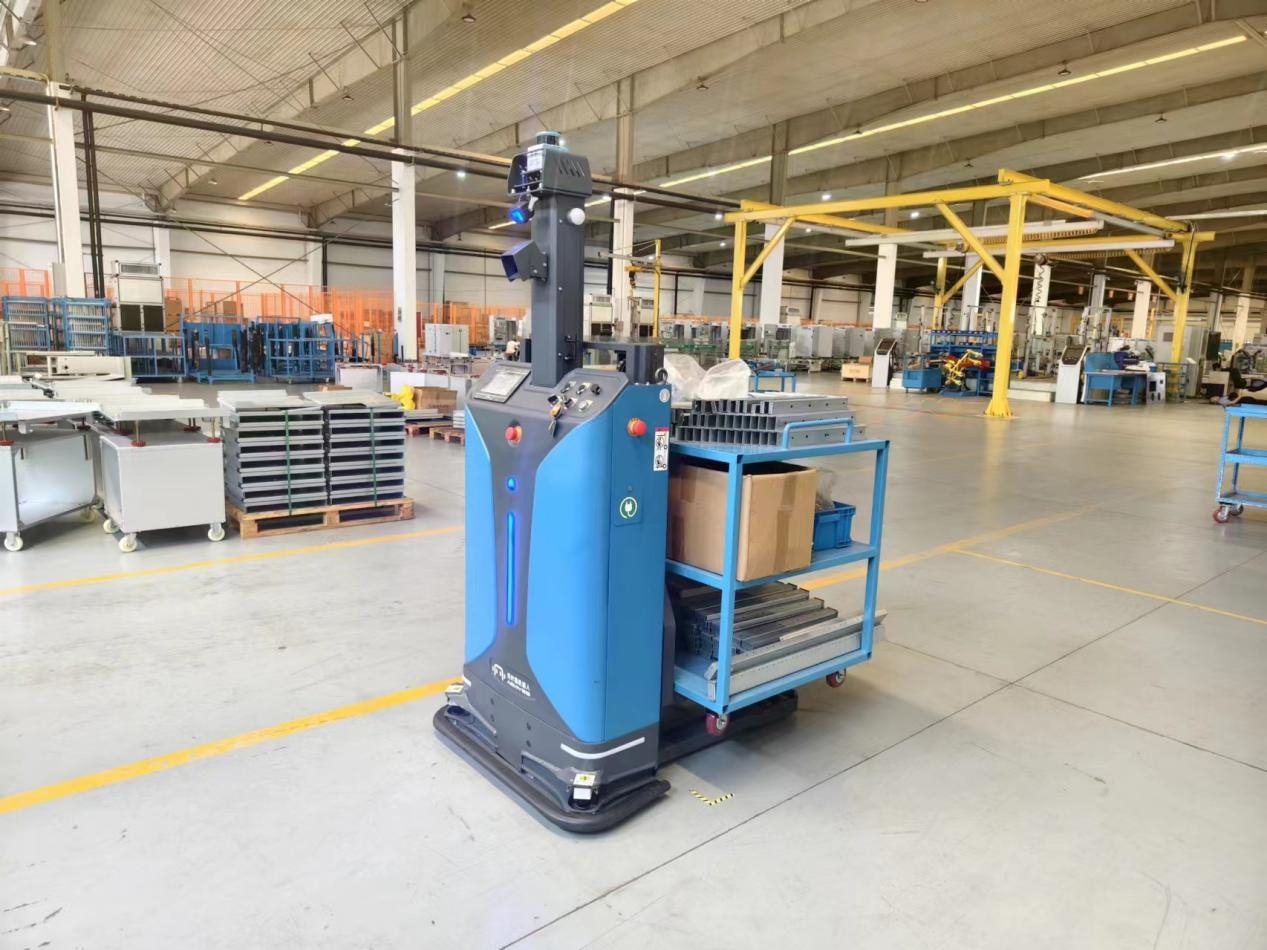
Addressing Core Industry Pain Points
Before the popularization of the AMR + unmanned forklift collaborative solution, the vast majority of enterprises’ warehousing logistics were trapped in three major “deadlocks”, each of which directly restricts production capacity, pushes up costs and causes missed business opportunities.
However, our products latent AMR carries shelves and actively arrives at the picking workstation, eliminating the need for staff to walk extensively across the warehouse from the root. Combined with the system’s order wave clustering algorithm to optimize picking arrangement, it completely overturns the backward operation mode of person-to-goods picking.
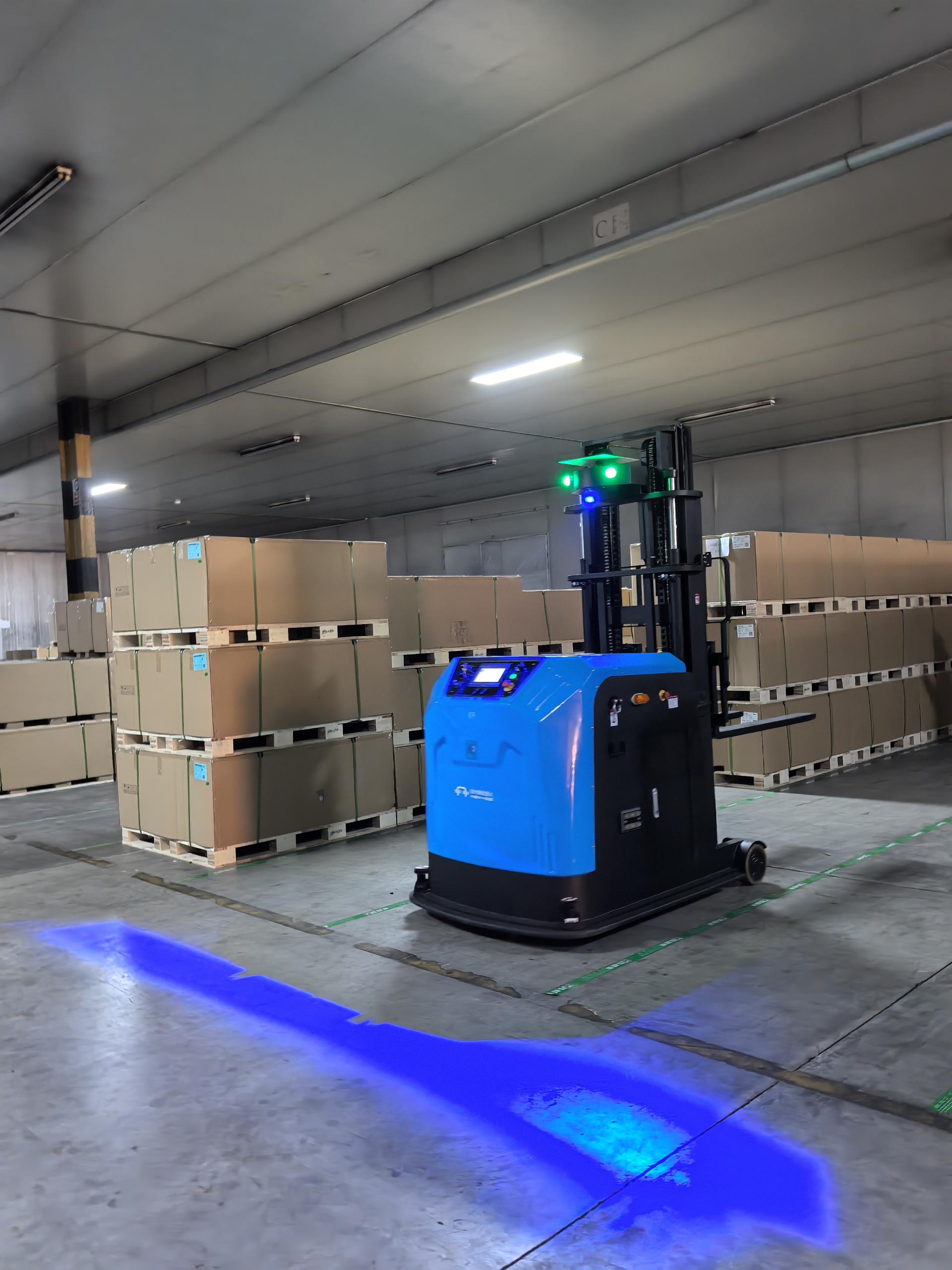
Core Logic: Full Process Unmanned Closed-Loop Operation
Before the popularization of the AMR + unmanned forklift collaborative solution, the vast majority of enterprises’ warehousing logistics were trapped in three major “deadlocks”, each of which directly restricts production capacity, pushes up costs and causes missed business opportunities.
Global Path Planning: No Collision, No Congestion, No Waiting, Maximum Traffic Efficiency. Different from the fixed path of stand-alone equipment, the collaborative solution realizes global dynamic path planning: the RCS system calculates the global optimal path in millisecond-level response, enabling AMRs and unmanned forklifts to travel on separate paths, operate at staggered peaks and avoid obstacles dynamically. Even in complex environments with passing personnel and temporarily stacked cargo, the two types of equipment can perceive the environment in real time through LiDAR and 3D vision, automatically detour and yield, solving the problems of intersection congestion and collision risk and improving operation smoothness.
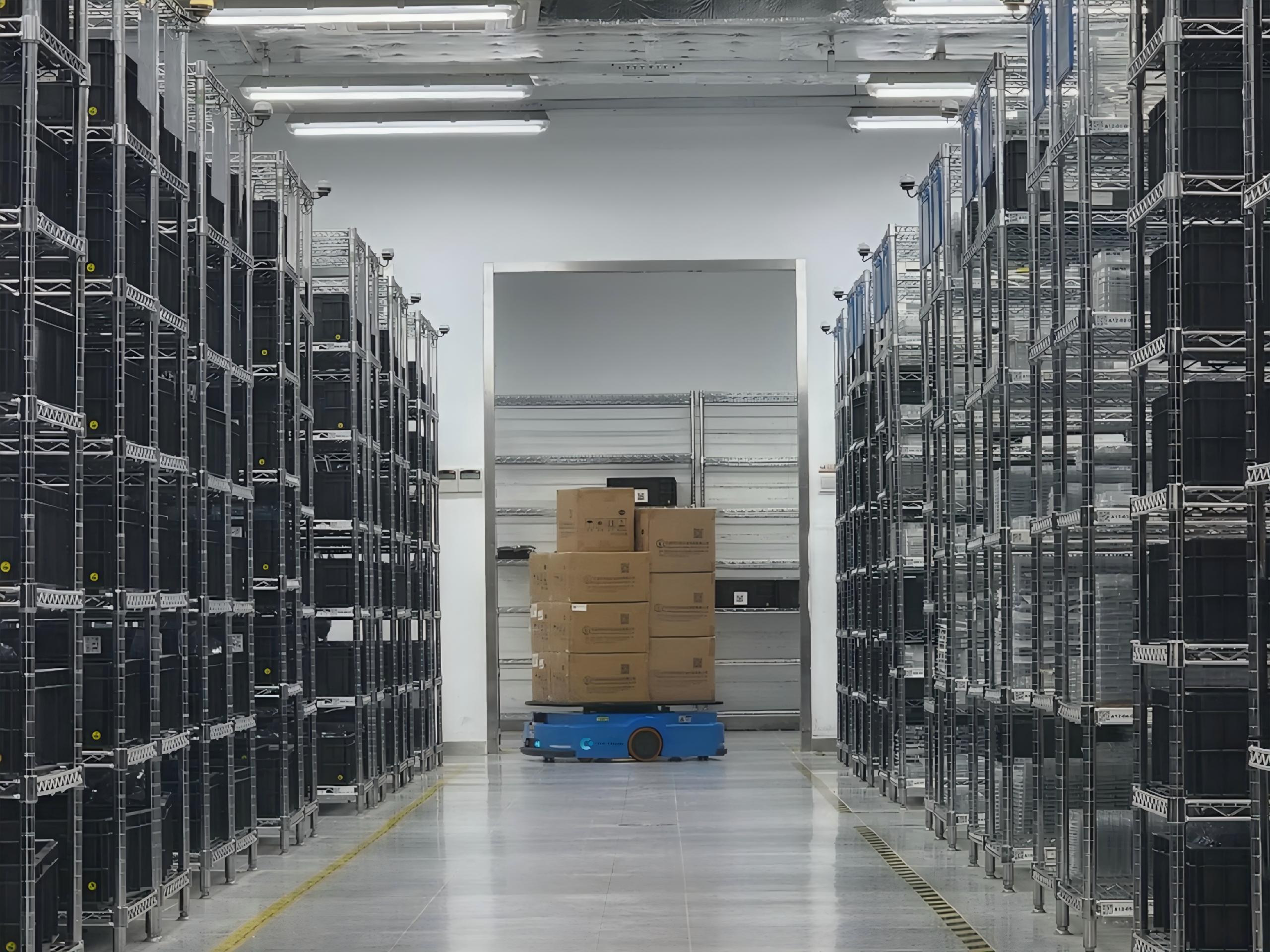
Centimeter-Level Positioning + Cluster Intelligence
Our product AMR + unmanned forklift collaborative solution relies on three core technologies to build a solid technical foundation for accurate and efficient operations, ensuring that every handling, every docking and every access is accurate and smooth.
Cluster Scheduling Algorithm: Collaboration of 200+ Devices, Millisecond-Level Decision Without Stuck. The core self-developed RCS cluster scheduling system supports more than 200 AMRs and unmanned forklifts to operate online at the same time. Through deep reinforcement learning and distributed algorithms, it achieves optimal allocation of multiple tasks, dynamic optimization of global paths and multi-machine collaborative obstacle avoidance.